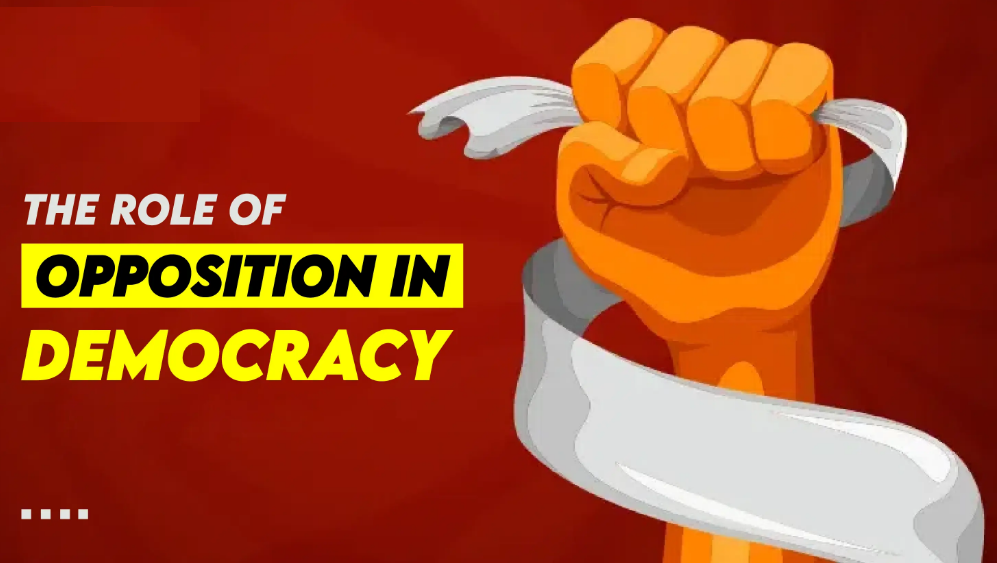

In a democratic regime, the opposition plays a vital and constructive role in ensuring that democracy functions effectively, transparently, and accountably. The opposition is not merely a rival to the ruling party but a fundamental pillar of democratic governance.
I. What is the Opposition in a Democracy?
The opposition refers to political parties or elected representatives who are not part of the ruling government but represent alternative voices in the legislature. Their primary role is to:
- Scrutinize government policies,
- Represent alternative ideas and interests,
- Protect constitutional rights,
- And provide checks and balances.
II. Constitutional and Institutional Significance
In parliamentary democracies like India or the UK, the Leader of Opposition is granted constitutional recognition and specific responsibilities, such as:
- Being a member of high-level appointments committees (e.g., CVC, CBI Director, Lokpal in India).
- Participating in debates, no-confidence motions, and legislative discussions.
In presidential democracies like the USA, the opposition plays a strong role through Congressional oversight committees.
III. Why Opposition Is Vital – Comprehensive Points
| Function | Explanation |
| 1. Ensures Accountability | The opposition questions government decisions, bringing transparency to public policies and financial expenditures. |
| 2. Provides Checks and Balances | Prevents misuse of power by scrutinizing executive actions and alerting the public to constitutional violations. |
| 3. Voice for the People | Represents dissenting views, minorities, and alternative social, economic, or cultural positions often overlooked by the ruling majority. |
| 4. Legislative Input | Suggests amendments, raises constructive debates, and contributes to improving the quality of laws. |
| 5. Democratic Stability | Encourages peaceful transfer of power and acceptance of electoral outcomes by maintaining the legitimacy of democratic processes. |
| 6. Watchdog Role | Through media and civil society support, it highlights issues like corruption, cronyism, and abuse of power. |
| 7. Alternative Governance | Acts as a government-in-waiting by preparing alternative policy blueprints and training future leaders. |
| 8. Encourages Public Debate | Facilitates healthy discussions on national issues which educate the public and deepen democratic participation. |
| 9. Bridges Grassroots Issues | Raises local and marginalized voices in national forums. |
| 10. Promotes Pluralism | Encourages multiple ideologies and policy frameworks, enriching the policy-making environment. |
IV. International Best Practices
| Country | Best Practice |
| UK | Recognizes “Her Majesty’s Loyal Opposition” with state funding and a formal shadow cabinet. |
| USA | Powerful Congressional Committees led by opposition investigate government actions (e.g., Watergate). |
| Germany | Opposition has proportional committee representation and media access to ensure parity. |
| Australia | Parliamentary Question Time is used by opposition to directly grill ministers under public view. |
| Canada | Maintains an open and civil opposition with access to briefing and policy documents. |
V. Challenges Faced by Opposition
| Challenge | Impact |
| Suppression through institutions | Undermines the capacity to hold the government accountable (e.g., misuse of ED, CBI in India). |
| Defection and poaching | Weakens legislative numbers and demoralizes opposition unity. |
| Polarization and media bias | Prevents the opposition from getting a fair platform to reach the public. |
| Lack of internal democracy | Weakens credibility and reduces leadership depth in opposition parties. |
VI. Indian Context
- Constitutional Role: No express definition, but recognized under rules of procedure of Parliament.
- Recent Issues:
- Weak opposition post-2014.
- Rising concerns of majoritarianism.
- Increased arrests or legal action against opposition leaders.
- Media portrayal often tilted, limiting the narrative space.
1. Government Stability
Bipolar System
- Clear majority governance: In a bipolar system, typically two dominant parties compete for power, leading to clearer outcomes in elections. This often results in a single party obtaining an outright majority, enabling it to form a government without coalition compromises.
- Stable governments: Such majority governments tend to be more stable, with fewer coalition breakdowns and easier passage of legislation.
- Predictability in governance: The political environment is more predictable because the opposition is institutionalized and the political contest is straightforward.
- Risk of polarization: However, this system often results in sharp political polarization, where the two parties represent opposing ideologies. This can lead to policy paralysis if parties block each other in checks and balances.
- Example: The US Congress often sees deadlock during divided government, despite the two-party dominance.
Challenges to Stability
- Slim majorities: Governments with narrow majorities can still face instability, especially if internal party dissent or defections occur.
- Extreme partisanship: When parties adopt extreme ideological stances, bipartisan cooperation declines, risking gridlock.
- Exclusion of minorities: Minor parties and marginalized groups are often excluded, which can fuel social tensions and undermine long-term stability.
Single-Party System
- High stability due to dominance: In single-party systems, a single party either legally controls or dominates the political landscape. This results in very stable governments since there is no competition.
- Efficient decision-making: Without opposition, governments can implement policies swiftly.
- Long-term planning: Absence of electoral competition allows governments to plan and implement long-term development strategies.
- Risk of authoritarianism: However, this concentration of power often leads to weakening of democratic norms, reduced accountability, and potential authoritarianism.
- Example: China’s one-party system is stable and efficient but is not a democracy. Some democracies like Singapore or dominant party systems like South Africa face concerns about opposition marginalization.
Challenges to Stability
- Lack of checks and balances: Without a genuine opposition, government accountability is weak, risking misuse of power.
- Internal factionalism: Stability might be undermined if the ruling party faces internal power struggles.
- Social unrest: Marginalized voices may turn to protests or unrest when denied political representation.
Multi-Party System
- Fragmented mandates: Multiple parties contest elections, rarely resulting in a single party majority.
- Coalition governments: Stability depends on coalition-building, which requires compromise among diverse parties.
- Consensus politics: Coalitions foster consensus and accommodate different social, ethnic, ideological groups.
- Fragile governments: However, coalitions are vulnerable to collapse, leading to frequent government changes, policy uncertainty, and political instability.
- Example: Italy has experienced frequent government changes due to coalition fragility; Germany, by contrast, has relatively stable coalitions due to strong institutions and political culture.
Challenges to Stability
- Power bargaining: Small parties may leverage their position to extract disproportionate benefits, potentially distorting governance priorities.
- Policy incoherence: Diverse coalition partners may have conflicting policy preferences, leading to diluted or inconsistent policies.
- Voter confusion: Excessive fragmentation can confuse voters and dilute clear political mandates.
2. Economic Growth
Bipolar System
- Policy continuity: Clear mandates often allow governments to enact economic reforms decisively.
- Market confidence: Investors may have greater confidence in stable governance, encouraging investment.
- Populist risks: However, electoral competition sometimes encourages populist economic policies, undermining fiscal discipline.
- Policy reversal risk: When power alternates, new governments may undo predecessors’ reforms, creating uncertainty.
- Examples: US economic cycles partly reflect shifts in political control; UK’s Thatcher-era reforms followed by partial reversals in subsequent governments.
Challenges
- Short-termism: Parties may prioritize short-term economic gains for electoral benefit over sustainable long-term growth.
- Polarization impacts: Deep political divides can stall critical economic legislation, harming growth.
Single-Party System
- Long-term strategic planning: Single-party systems often excel in consistent, long-term economic policy implementation.
- Rapid infrastructure and industrialization: Without opposition constraints, governments can execute ambitious infrastructure, industrial, or technology projects.
- Efficient resource mobilization: Centralized decision-making allows quick resource allocation to priority sectors.
- Example: China’s economic boom is often attributed to the Communist Party’s ability to focus on long-term growth strategies.
- Risks: Lack of transparency and accountability can cause corruption and misallocation of resources. Growth might prioritize GDP without addressing inequality or environmental degradation.
Challenges
- Innovation stifling: Lack of political competition may stifle economic innovation and adaptability.
- Neglect of marginalized sectors: Without pressure from opposition or civil society, some economic groups or regions may be neglected.
- Potential for crony capitalism: Concentrated power can promote elite capture.
Multi-Party System
- Inclusive growth focus: Multi-party coalitions often incorporate social welfare and equity concerns into economic policy.
- Balanced economic policies: Compromises among parties balance growth with labor rights, environmental protection, and redistribution.
- Innovation through pluralism: Diverse political competition fosters policy experimentation and innovation.
- Examples: Scandinavian countries combine coalition governments with high growth, innovation, and strong social protections.
- Challenges: Complex coalition negotiations can delay reforms or lead to watered-down policies.
Challenges
- Policy gridlock: Coalitions with conflicting interests may stall necessary but politically difficult reforms.
- Short-term compromises: Political partners may prioritize immediate electoral gains over long-term growth.
- Fiscal discipline issues: Coalition partners demanding populist spending can undermine fiscal sustainability.
3. Sustainable Development Goals (SDGs)
Bipolar System
- Focused implementation: Governments with clear mandates can channel resources to SDG priorities.
- Politicization risk: SDGs may be used as political tools rather than genuine development goals.
- Opposition oversight: Strong opposition can hold governments accountable for SDG progress.
- Challenges: Short electoral cycles and partisan politics may limit commitment to long-term SDGs.
Single-Party System
- Long-term SDG planning: Ability to integrate SDGs into national development plans and implement them over time.
- Centralized execution: Enables coordinated efforts in poverty alleviation, education, health, and environmental sustainability.
- Risks: Lack of transparency and civil society participation may undermine SDG goals related to inclusion and rights.
- Examples: China’s poverty alleviation programs show effective centralized SDG-aligned efforts, but environmental and social rights concerns persist.
Multi-Party System
- Broad stakeholder inclusion: Multi-party systems enable inclusion of diverse groups in SDG planning and monitoring.
- Social and environmental justice: Parties representing marginalized groups often push for equity-focused SDGs.
- Accountability and transparency: Coalition governments are usually more responsive to civil society demands.
- Challenges: Political instability can disrupt SDG continuity; coalition compromises may weaken commitments.
Comprehensive Summary Table
| Aspect | Bipolar System | Single-Party System | Multi-Party System |
| Government Stability | Usually stable with clear mandates; risk of polarization and gridlock | Highly stable but risks authoritarianism and weak accountability | Consensus-driven, inclusive but can be fragile and unstable |
| Economic Growth | Policy clarity aids growth; risk of reversal and populism | Long-term planning fuels rapid growth; risk of corruption and inequality | Inclusive, balanced growth; slower reforms and risk of policy gridlock |
| SDG Implementation | Focused but politicized; short-term electoral cycles limit long-term impact | Strong long-term programs; risk of exclusion and low transparency | Inclusive and accountable; risk of instability and diluted policies |
Additional Factors Impacting These Systems
- Electoral Systems
- First-past-the-post favors bipolarism (e.g., USA, UK).
- Proportional representation favors multi-party systems (e.g., Germany, Netherlands).
- Political Culture
- Countries with a culture of consensus manage multi-party coalitions better.
- Civil Society and Media
- Vibrant civil society strengthens opposition roles in all systems, improving accountability.
- Judicial Independence
- Courts act as a check on power, especially critical in single-party dominant systems.
Conclusion
- Bipolar systems balance stability and accountability but struggle with polarization and marginalization.
- Single-party systems can deliver rapid growth and policy consistency but pose democratic and inclusion risks.
- Multi-party systems are best suited to pluralistic societies aiming for inclusive growth and SDG achievement, despite challenges of instability and policy compromise.
The best system depends on a country’s social fabric, institutional strength, and democratic maturity.