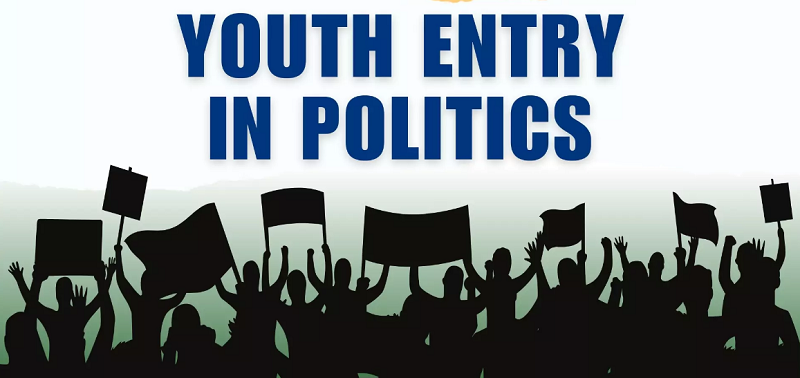

The coming of youngsters in politics acts as a game changer due to their potential to bring fresh ideas, energy, and inclusivity into a system often criticised for being slow, hierarchical, and resistant to change. Below is a comprehensive explanation of how and why young people entering politics can transform the political landscape:
Game- Changing Impacts of Youngsters in Politics
1. Infusion of New Ideas and Innovation
- Tech-savvy and connected: Youth bring digital literacy, use of data, social media, and AI in policymaking and campaigning.
- Policy innovation: Young leaders often advocate for cutting-edge ideas—climate action, gig economy rights, digital privacy, crypto regulation, etc.
- Global exposure: Many are educated globally and bring comparative perspectives to governance.
Example: Finland’s Sanna Marin (became PM at 34) brought climate, education, and welfare reforms with a tech-forward vision.
2. Bridge Between Government and Youth
- Demographic dividend: In countries like India where over 65% population is under 35, youth leaders represent this majority more effectively.
- Policy relevance: Youth are more attuned to issues like unemployment, student debt, mental health, and start-up ecosystems.
- Increased voter engagement: Young politicians energize apathetic or first-time voters, increasing democratic participation.
Example: Voters under 25 were key to Barack Obama’s election, thanks to youth-led outreach and digital campaigning.
3. Challenge to Traditional Power Structures
- Merit over dynasty: Emerging youth leaders often reject nepotism and feudal politics, promoting merit-based systems.
- Anti-corruption stance: Young leaders often position themselves against the status quo, calling out inefficiency and corruption.
- Internal party democracy: They push for transparency and democratic structures within political parties.
Example: In India, leaders like Chandrashekhar Azad Ravan and Jignesh Mevani emerged through activism, not family background.
4. Diversity and Inclusion
- Social representation: Young leaders come from varied castes, classes, genders, and geographies.
- Progressive agendas: They often prioritize issues like LGBTQ+ rights, menstrual health, environmental justice, etc.
- Grassroots connection: Many enter politics via social movements or youth organizations, giving them strong grassroots links.
Example: Alexandria Ocasio-Cortez (elected at 29) challenged Wall Street-backed politics and brought working-class issues to the U.S. Congress.
5. Change in Political Culture
- Transparent leadership: Young politicians are often more comfortable with public scrutiny and open communication.
- Dialogue and debate: They value reasoned debate over political muscle, often promoting participatory governance.
- Use of technology for transparency: Online manifestos, participatory budgeting, and public grievance redressal via apps.
Example: In Taiwan, digital minister Audrey Tang (appointed at 35) led civic tech innovations like vTaiwan for participatory governance.
Challenges Young Politicians Face
- Lack of funding and party support
- Resistance from old political guards
- Trolling and cyber-harassment, especially for women
- Tokenism – being used as showpieces without real power
- Navigating political violence and dirty tactics
Indian Committees and Government Bodies
1. Justice V.S. Krishna Iyer Committee on Electoral Reforms (1994)
- Recommended: Greater youth participation and education in democratic processes.
- Suggested: Political education and democratic values be embedded in schooling to prepare youth for political roles.
2. Second Administrative Reforms Commission (ARC) – 2007
- Chairperson: Veerappa Moily
- Recommendation: Encourage internal democracy in political parties to give space to young, grassroots leaders.
- Called for:
- State funding of elections to reduce money power (a barrier for young aspirants)
- Training and leadership development for political aspirants
3. National Youth Policy (NYP) – 2014
- Released by the Ministry of Youth Affairs and Sports
- Objective: “To empower youth to participate in politics and governance.”
- Key recommendations:
- Youth Parliament programmes in schools and colleges
- Leadership training for young aspiring politicians
- Inclusion of youth representatives in local bodies
4. Election Commission of India (ECI)
- Through Systematic Voters’ Education and Electoral Participation (SVEEP) initiative:
- Conducts awareness drives in colleges and youth groups
- Encourages young voters to register and contest elections
- Recommends:
- Lowering entry barriers for young independent candidates
- Stronger regulation on money power to give youth a fair chance
5. National Commission for Women (NCW) & Ministry of Women and Child Development
- Suggested gender-based youth reservation/quota in political parties to support young women’s entry into politics.
- Support for training and security for young female political candidates.
6. Law Commission of India – Various Reports
- Has recommended internal reforms in political parties that include:
- Regular internal elections
- Quotas or incentives for young candidates
- Term limits to prevent gerontocracy (rule by old people)
International Committees and Bodies
1. Inter-Parliamentary Union (IPU) – Geneva
- Report: “Youth Participation in National Parliaments” (latest in 2021)
- Key findings:
- Globally, only 2.6% of MPs are under 30.
- Recommends:
- Youth quotas in parliaments
- Youth wings in political parties
- Parliamentary internships and leadership fellowships
2. United Nations Development Programme (UNDP)
- Publishes Youth Global Programmes
- Recommends:
- Youth inclusion as a governance indicator
- Electoral and political finance reforms to remove barriers for youth
- Youth policy integration in national development plans
3. Commonwealth Youth Programme (CYP)
- Advocates for:
- “50:50 by 2030” youth representation
- Establishment of youth caucuses in parliament
- Youth political education and capacity-building
4. OECD Report on Youth and Democracy (2018)
- Recommends:
- Youth quota laws
- Youth-specific party reforms
- Open primaries for candidate selection to encourage young voices
- Reducing age limits for running for office
Other Institutional Recommendations
➤ National Youth Parliament Scheme (India)
- Suggested by various committees to be expanded to state and district levels
- Aims to develop leadership skills and political literacy among youth
➤ NITI Aayog (via Atal Innovation Mission)
- Indirectly encourages youth leadership through entrepreneurship, which is often a precursor to political engagement in India
Suggested Structural Reforms
| Recommendation | Source |
| Lower age limits for contesting elections (esp. to Lok Sabha) | Law Commission, IPU |
| Mandatory youth quotas in party candidate lists | IPU, UNDP, ARC |
| State funding of elections to support young candidates | ARC, Law Commission |
| Capacity building and mentorship for youth politicians | NYP, Commonwealth, ECI |
| Strengthening internal democracy in parties | ARC, Law Commission |
| Encouraging student unions and campus politics | NYP, UNDP |
INTERNATIONAL BEST PRACTICES TO INCREASE YOUTH PARTICIPATION IN POLITICS
1. Sweden – Youth Quotas in Political Parties
- Most major parties voluntarily implement quotas for youth (typically under 35) in their electoral candidate lists.
- Encouraged by strong party internal democracy and gender-equality movements.
- Result: Over 13% of MPs are under 30 (among the highest in the world).
Best Practice: Voluntary youth quotas + internal party democracy ensures balanced generational representation.
2. New Zealand – Lower Age of Candidacy
- Minimum age to contest for Parliament is just 18 years, same as voting age.
- Supported by:
- Civic education at school level
- High voter literacy
- Jacinda Ardern became PM at 37, and there are multiple MPs under 30.
Best Practice: Equalization of voting and candidacy age promotes early political careers and inspires participation.
3. Colombia – Youth Councils (Consejos de Juventud)
- Mandatory Youth Councils elected every 4 years.
- These are institutionally linked to municipal governments and have budgetary influence.
- Ensures early engagement with democratic institutions and training grounds for future politicians.
Best Practice: Formal youth governance bodies give real political training and decision-making power.
4. Rwanda – Reserved Parliamentary Seats
- 2 reserved seats for youth in the national Parliament (along with 24 for women).
- There’s also a National Youth Council with constitutional recognition.
- Youth representation is linked with post-conflict nation-building and inclusive development.
Best Practice: Legally mandated youth representation backed by constitutional frameworks.
5. Switzerland – Youth Parliaments (Jugendparlamente)
- Non-partisan, youth-led local parliaments where teenagers simulate law-making and influence local governance.
- Some regions even allow them to introduce real proposals to city councils.
Best Practice: Non-partisan youth platforms that directly feed into formal decision-making structures.
6. Norway – Political Party Funding Linked to Youth Participation
- Parties with active youth wings and internal elections receive higher public funding.
- Incentivizes youth outreach and inclusion.
Best Practice: Funding incentives tied to youth inclusiveness in party structures.
7. Senegal – Youth-Focused Political Education
- Integrated civic and political education from secondary school onwards.
- Created a generation of politically active youth, some elected to Parliament in their early 20s.
Best Practice: Integrated civic-political education starting from school.
8. Canada – Youth Ministers & Advisory Bodies
- Appointed Minister for Youth (PM Justin Trudeau held this portfolio himself).
- Prime Minister’s Youth Council gives non-partisan input on national policies.
Best Practice: Youth advisory bodies to the executive government create direct influence channels.
FUTURE PREDICTIONS AND GLOBAL TRENDS
1. Legally Mandated Youth Quotas Will Increase
- Similar to gender quotas, more countries are expected to legislate youth quotas at local and national levels.
- Could range from 5–20% reserved seats or candidacies for people under 35.
Predicted by: Inter-Parliamentary Union, UNDP
2. Digital Platforms Will Democratize Political Entry
- Use of blockchain voting, AI-based public feedback systems, and online primaries will give young digital natives an edge.
- Startups like Polis (Taiwan) and Decidim (Spain) will empower youth-led civic tech governance.
3. Mandatory Political Literacy in Education Curricula
- Countries will increasingly embed politics, law, and democratic process education into school curricula.
- Expected in EU countries, India, and parts of Latin America by 2030.
4. Rise of Transnational Youth Movements
- Youth will participate in borderless political action on climate, digital rights, and peace.
- E.g., Greta Thunberg’s Fridays for Future, or #MarchForOurLives (US gun reform) will serve as talent pools for political leadership.
5. Legal Reform of Age Restrictions
- Many countries are expected to lower minimum age for contesting elections to match voting age (18).
- Will likely begin in Latin America, Europe, and parts of Africa.
6. Youth-Centric Political Parties Will Emerge
- Just as Green Parties emerged in the 1980s-90s, new parties entirely led by and focused on youth (18–35 age group) will rise.
- Example: Volt Europa – pan-European youth-led political party.
7. Global Benchmarking on Youth Inclusion
- UN or IPU may introduce an annual “Youth Inclusion in Politics Index” that ranks countries on youth political participation.
- Could influence foreign aid, investment, and public perception of governance quality.
PROS (Advantages of Youngsters in Politics)
1. Policy Innovation and Fresh Ideas
- Young leaders bring new perspectives, often influenced by global exposure, technology, sustainability, and rights-based governance.
- More likely to push for:
- Climate change action
- Digital economy regulation
- Startup and gig economy support
- Education reform and mental health
Example: Finland’s young Prime Minister Sanna Marin brought progressive family and environmental policies.
2. Digital-Native Leadership
- Today’s youth are native users of technology, enabling:
- Tech-enabled governance (e-governance, social media communication, blockchain in public finance)
- Transparent, accessible, and real-time engagement with citizens
- Digital public grievance redressal
Example: Taiwan’s Audrey Tang (Digital Minister, age 35) implemented participatory AI tools for legislation.
3. Stronger Connect with Youth Population
- In countries like India, where over 65% of the population is below 35, young politicians:
- Represent their aspirations more effectively
- Mobilize first-time and youth voters
- Focus on employment, skill development, education, and entrepreneurship
4. Challenge to Dynastic and Old Guard Politics
- Youth entry breaks the monopoly of elite families, political dynasties, and gerontocracy.
- Supports merit-based leadership and broadens political entry points (activism, entrepreneurship, student movements).
Example: Jignesh Mevani (India), Alexandria Ocasio-Cortez (USA), and many others rose outside traditional party structures.
5. Enhanced Political Participation and Voter Turnout
- Youth politicians increase the engagement of young voters who feel disconnected from traditional politics.
- Results in:
- Higher voter registration
- Increased turnout
- Politicization of youth on policy, not just identity
6. Energy, Dynamism, and Adaptability
- Young leaders often show greater adaptability, energy, and responsiveness.
- Easier acceptance of reforms, feedback, and innovation in governance structures.
7. Gender and Social Inclusion
- Youth-led movements often challenge caste, class, and gender hierarchies.
- Young women, LGBTQ+, and marginalized community leaders find more entry space via youth-based politics.
8. Global Outlook and Soft Power Enhancement
- Young leaders trained or exposed globally bring cosmopolitan thinking, aligning national policies with global agendas (SDGs, Paris Agreement, etc.).
- Boosts a country’s global image and influence.
CONS (Challenges and Risks of Youngsters in Politics)
1. Lack of Experience and Maturity
- Young politicians may lack:
- Deep understanding of constitutional processes
- Negotiation and diplomacy skills
- Administrative experience
- May act impulsively or be manipulated by seasoned elites.
Example: Poor handling of sensitive issues, or hasty decisions due to populist pressure.
2. Populism and Identity Politics
- To gain quick popularity, young leaders may:
- Use divisive identity politics
- Indulge in symbolism over substance
- Rely on media virality rather than long-term policymaking
Example: Viral social media campaigns replacing serious legislative work.
3. Vulnerability to Manipulation
- Youth in politics may become fronts for senior leaders, business interests, or criminal groups.
- Many parties use youth faces for image-building but centralize real power.
Example: “Poster boy/girl” candidates without real authority in internal party functioning.
4. Financial Constraints
- Young aspirants often lack the funding and network required to win elections.
- Can lead to:
- Dependence on moneyed interests
- Use of unethical means to raise campaign funds
5. Disruption of Institutional Continuity
- Too much emphasis on youth could risk disregarding institutional memory and experience-based decision-making.
- Could lead to short-termism over strategic, long-term planning.
6. Risk of Political Tokenism
- Parties may promote a few youth faces just for optics (esp. during elections or international events), without giving them real decision-making power.
- Token representation ≠ actual inclusion.
7. Over-politicization of Youth
- Excessive political involvement in colleges/universities can dilute focus on academics, create campus violence, and increase polarization.
- Risks turning student politics into vote-bank breeding grounds.
8. Generational Divide and Resistance
- Older leaders may resist sharing power, leading to internal friction.
- Public perception may mistrust younger leaders as “too immature” or “too radical.”
Balanced Conclusion
| Aspect | Contribution of Youth Politics |
| Policy Innovation | High: New areas, tech-led thinking |
| Governance Skills | Mixed: Learning curve involved |
| Representation | Strong: Closer to the real demographic |
| Risks | Populism, inexperience, manipulation |
| Solution | Balanced youth-elder collaboration, structured mentorship, internal democracy |
The optimal approach is not to replace old with young, but to blend experience with fresh energy. Institutionalizing reforms—like internal democracy in parties, mentorship pipelines, financial transparency, and policy literacy—can maximize the benefits of youth participation while minimizing its risks.
I. Institutional Reforms in Political Parties
Objective:
Make parties more democratic, inclusive, and youth-friendly
Key Strategies:
- Mandatory Internal Elections (with oversight by ECI or Lokpal-type body)
- Incentives for Youth Quotas in Candidate Lists (e.g., 20% under 35)
- Youth Wings with Budget and Autonomy
- Term Limits and Age Caps for Party Leadership (e.g., no post for >70 unless in Parliament)
Institutional Responsibility:
- Election Commission of India (ECI)
- Law Commission
- Ministry of Law and Justice
- Political Parties (self-regulation)
Implementation Mechanism:
- Amend Representation of People Act to regulate inner-party democracy
- Tie public funding or symbol allotment with democratic compliance
- Monitor candidate demographics
II. Civic and Political Education Reforms
Objective:
Embed political literacy and public leadership skills in youth from early stages
Key Strategies:
- Political Literacy Curriculum in Class 9–12 and undergraduate level
- Simulated Parliament Debates, Constitution clubs, Model UNs
- Mandatory Civic Internship with MPs/MLAs, local governments
- Youth Voter and Candidate Awareness Campaigns via SVEEP
Institutional Responsibility:
- NCERT, UGC, AICTE
- Ministry of Education
- Election Commission (SVEEP)
Implementation Mechanism:
- Curriculum redesign under NEP 2020
- Mandatory community service hours including political shadowing
- Collaborate with NGOs and Election Commission
III. Legal and Electoral Reforms
Objective:
Remove age and financial barriers, enhance fair access for young candidates
Key Strategies:
- Lower Age of Contesting Lok Sabha to 21 (from 25)
- Cap Election Expenditure for First-Time Candidates
- Public Campaign Finance for Young Candidates (e.g., vouchers or reimbursement)
- Reserved Seats or Candidate Quota for Youth in Urban and Panchayat Bodies
Institutional Responsibility:
- Law Commission of India
- Election Commission of India
- Parliament (for amending laws)
Implementation Mechanism:
- Amend Representation of People Act, 1951
- Create “Youth Political Access Fund”
- Mandate disclosures of candidate age and campaign spending
IV. Institutional Platforms for Youth Participation
Objective:
Create formal, structured bodies for youth policymaking and advisory roles
Key Strategies:
- Establish National Youth Parliament Council (NYPC) as a statutory body
- Youth Representation in Standing Committees, Panchayats, Municipal Bodies
- District Youth Governance Forums chaired by DM/Collector
- Youth-Led Think Tanks in collaboration with NITI Aayog
Institutional Responsibility:
- Ministry of Youth Affairs & Sports
- NITI Aayog
- MoPR (Panchayati Raj)
Implementation Mechanism:
- Draft new “Youth in Politics Promotion Act”
- Annual Youth Policy Dialogue Sessions with PM/CMs
- Embed youth observers in policy evaluations
V. Mentorship, Leadership and Political Incubation
Objective:
Train, mentor, and incubate youth for long-term political careers
Key Strategies:
- Public Leadership Fellowships (like PM-YUVA, LAMP Fellows) for aspiring leaders
- Cross-party Youth Leadership Academies at state and national levels
- Mentorship Program with Retired Bureaucrats, MPs, Judges
- Partnerships with civil society and universities for political innovation labs
Institutional Responsibility:
- Ministry of Skill Development
- Election Commission
- State Youth Departments
Implementation Mechanism:
- Government-Private-CSO collaboration
- Dedicated portal for mentorship and fellowships
- Tie-up with Harvard Ash Center, LSE, Ashoka, etc.
VI. Tech-Enabled Democratic Access
Objective:
Use digital platforms to lower entry barriers and enhance participation
Key Strategies:
- Online Candidate Filing for Local Elections
- Blockchain-Based Internal Elections in parties
- Public Leader Scorecard Portals (for transparency & access)
- Youth Participation Apps for feedback and policymaking
Institutional Responsibility:
- Ministry of Electronics & IT (MeitY)
- Election Commission
- State IT Departments
Implementation Mechanism:
- Expand DigiYatra/DigiLocker integration with political candidacy portals
- Mobile applications for youth governance consultation
- Data transparency and real-time political access dashboards
VII. Social Inclusion & Diversity in Youth Politics
Objective:
Make youth political access equitable across caste, gender, region, and class
Key Strategies:
- SC/ST/OBC/Women Youth Quotas in Political Fellowships
- Youth Political Scholarships for economically weaker sections
- Anti-Harassment Framework for women and LGBTQ+ youth in politics
- Special Zones and Trainings in Conflict/Tribal Areas
Institutional Responsibility:
- Ministry of Social Justice
- National Commissions (SC/ST/OBC/Women)
- State Youth Commissions
Implementation Mechanism:
- Mandatory social audit of political representation
- Community-based recruitment and sensitization programmes
- Protected budget allocation for marginalised youth candidates
CONCLUSION: INTEGRATED IMPLEMENTATION MODEL
| Pillar | Target Outcome by 2030 |
| Institutional Party Reform | 25% candidates under 35 in all major parties |
| Civic Education | 90% youth political literacy rate (15–24 years) |
| Electoral Reform | 30% youth candidates at Panchayat and ULB levels |
| Formal Youth Platforms | National Youth Parliament Council + District Forums |
| Leadership Development | 5 lakh youth trained in leadership fellowships |
| Tech Integration | All local elections digitally accessible to youth |
| Inclusion and Diversity | Youth representation from all social groups ensured |